Showing posts with label headphones. Show all posts

Tuesday, March 5, 2013

Are Child Headphones Worth It?

With the increasing use of technology by younger and younger children, the amount of accessories marketed directly for them is increasing. Everything from child-friend iPad cases to security software for mobile devices and child headphones. These headphones are smaller than most, but still over the ear style. Usually costing the same or slightly more than comparable headphones, it's wise for a parent to shop around and do research before purchasing a pair.

Child headphones are, like I said, smaller to accommodate the smaller cranium sizes of youths making it much more comfortable for a child to wear than larger adult sets. This isn't a big deal for short-term use, but for longer periods like watching a movie in the back seat of a car on a long car trip, it can make a difference, though the exactly amount or type has not been studied thoroughly.

They also have built in volume controls. This is by far my favorite feature of child headphones. I can't tell you how many times I've accidentally blasted my own ears starting some music when the volume had been turned up without me knowing. Built in volume controls mean that even if the device they're plugged into is set to play loudly, the headphones have a maximum level that will lower the volume to a safe level for their ears.

Lastly, they look cool! I mean, check out this pair by DreamGear. With cute pictures and characters on them, children often get attached to their headphones as it allows them to have their set that. This means they'll (theoretically) stay away from your expensive Bose set, and opt for their own.

Practical Tip of the Day:
Be careful giving your child any electronic device or accessory and leaving them unattended. Smaller children may chew on cables or get tangled in the wire. Always exercise common sense and caution when giving your child a new item. I personally did not let my child use her headphones unattended until she was five, and I still do not let her use them for more than 10 minutes at a time except for special occasions like the aforementioned long car trips.

Thursday, July 19, 2012

What's the Difference Between Noise Cancelling & Noise Isolating?

In the market for a nice set of headphones? Not sure which type to get? It's usually pretty easy to decide whether you want small headphones that go in your ear, or bigger ones that go on or over your ears. Similarly, finding good quality sound is as simple as either trying them out in-store or finding a review of them online. The one thing that I've found people get confused about though is the difference between noise isolating and noise cancelling headphones.

They sound practically identical, and they can have similar effects, but the way these two technologies work is completely different. Noise isolating headphones are generally in-ear headphones; These are the small buds that actually go inside your ear canal. They work just like ear plugs by filling your ear canal so no outside sound can come in. If you imagine ear plugs that have tiny speakers in them, that's exactly what noise isolating is. They physically block out sound while piping in your audio through the same plugs.

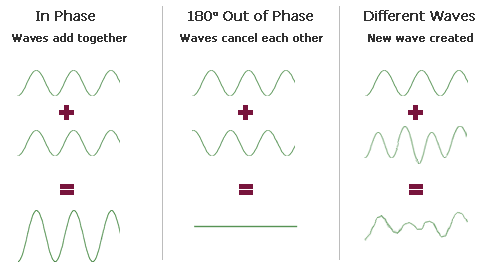
Noise cancelling is a lot more complicated and thus usually a lot more expensive than noise isolating. As you may know, sound travels in waves. Noise cancelling headphones actually produce sound waves that cancel out the most common "noises." Here's a quick diagram from mediacollege.com that shows what happens:

Noise cancelling is the middle example. You have two waves that are complete opposites and when they hit each other they cancel out-- hence noise cancelling. At this point you may be asking how the headphones can make such a sound to do this. Not nearly as easily as noise isolating, that's for sure. Noise cancelling headphones are going to be over the ear headphones, meaning they're actually little cups that go over your entire ear, and in those cups it's going to have the hardware that makes those sound waves and the extra batteries required to make them. That's right, noise cancelling headphones usually require their own separate batteries.

Practical Tip of the Day:
If you're looking for noise reduction during your gym visit, I generally recommend getting noise isolating in-ear headphones. Their smaller design and smaller price point makes them good gym buddies since you won't be walking around the gym floor with big $300 headphones on. If you travel a lot, especially by plane or train, noise cancelling might be better as they can reduce noise more, and generally people find them more comfortable for long-term wear since they don't actually enter your ears.