Tuesday, August 14, 2012

What is Push Notification?

Looking for a new email or maybe you have one and just noticed this as a feature? We know what "push" means, and what "notifications" are, but put in a technological light, what does the phrase "push notification" mean? This is, thankfully, one of the times that a technological phrase means exactly what it says. Push notifications are when notifications (emails, messages, etc.) are "pushed" to your device.

A good (though not quite perfect) example of this is email. I have two email accounts; One has push notification, one doesn't. When I look at my smart phone to see if I have any emails, I'll have a number next to my email icon if I received an email to the account with push notification. That's because the email was "pushed" down to my phone as soon as it arrived. If I want to see if I have any emails to my other account (the one without push notification), I have to open up my email and tell it to check for new messages. This is called "fetching" because I'm telling my device to go up to where the emails are held and fetch copies of them.


Another way of explaining it, if you're not that familiar with email, is like your actual mail. Normally, you have to go out to your mailbox to see if you received any mail today. That's how normal email works. If, on the other hand, every time you received a new piece of mail the mailman came up to your door, knocked, and hand delivered each piece to you as it arrived at the post office that would be "pushed." (And yes, I know it would be physically impossible, but that's how convenient push is for mail.)

The email analogy isn't perfect though because emails aren't really "notifications" per se, but I find that to be the easiest way for people to originally understand the idea. Normally, notifications are things like in the above image: small notifications sent from applications you have on your device that pop up when they are triggered. This could be upgrade notifications, news reports, weather alerts, reminders, etc., but the general term "push" is universal between all those examples and the email analogy.

Practical Tip of the Day:
Most applications have a default setup for what things trigger notifications and how they're displayed. If you find that you're getting too many notifications from a particular app, go into the settings. There is almost always a way to minimize or even turn off notifications for individual or all applications.

Thursday, August 9, 2012

What is Syncing?

Let's say you have a computer and an MP3 player. (Click here if you don't know what an MP3 player is.) How do you get the songs you want from your computer onto the player? You sync them! What in the world does that mean? "Syncing" is short for "synchronizing," and it does just that; it synchronizes the information from two devices.

If two people are doing synchronized swimming, they're swimming in the exact same way. If two devices are synchronized, they have the same information on them. Lots of different devices can be synchronized: MP3 players, computers, smartphones and even more obscure concepts like "the cloud" can be synchronized with your information. If you're syncing something like a smartphone, you're often connecting it to your computer- either physically or wirelessly- and software on the computer walks you through the process of picking which things you'd like to sync. Here's an example of iTunes (a computer program) syncing an iPod (an MP3 player):


On the more obscure end, things like your bookmarks can be synced between devices using various methods. Bookmarks are website address you've saved so you can easily go back to the website without having to search or remember the address. It's like speed-dial for the Internet. Using a service like Google, you can have a bookmark created on your work computer appear on your home computer by syncing the two computers. See how this can be very handy? On the downside, if something gets messed up, you could also end up with doubles or triples of your items or worse yet, end up loosing the synced information entirely.

Practical Tip of the Day:
Before starting to sync information, make sure you have a backup of your information just in case one of those worse-case-scenarios happens. That way, if you botched syncing your address book from your phone to your computer and loose them all, you can go back to your backup and get them all over again.

Tuesday, August 7, 2012

How Can I Get My Home Movies Onto My Computer?

Remember that camcorder you purchased back in the 80's or 90's? The one that recorded onto a VHS or mini-VHS tape? Do you even still have a VHS player in your house? More and more, people are wanting to digitize their older media (media being photos, movies, and audio) to get it onto the computer where they can edit and share it. The trick is, how do you get the videos from your old camcorder onto your computer?

A digital video converter is what you need! These small, handy devices plug into your VCR, camcorder, or any other device with the above shown plugs on one end and into your computer on the other end. Using software that comes with the device, you can then easily bring the video into your computer in varying quality, formats and sizes. The product shown above is made by a company named Elgato which specializes in video devices for computers and gets very good reviews. You can find their webpage here.

Just like with converting your old photos into digital versions (click here on how to do that), you want to first shop around for places that will do it for you for a fee and compare the cost of purchasing the equipment and doing it yourself with the cost of hiring a person or company to do it for you. A company can often do it faster, but being able to do it on your own time and in the privacy of your own home can be nice as well.

Practical Tip of the Day:
Video converters can do lots of other things. For example, Elgato also makes a product that lets a person record their video game screen from a console like an Xbox or Playstation. This can be a nice gift for the video gamer in your family that you struggle to find something for. This device will record their game play, and then they can edit it to make movies to share with their friends, family, or post to websites like Youtube.

Thursday, August 2, 2012

How Can I Watch the Olympics on My Computer?

With the Olympics going on, lots of people are asking how they can watch it on their computers. NBC here in the US has Olympic coverage pretty well controlled and unviewable on the internet except by use of their mobile application on smartphones and tablets, but what if you want to watch it on your desktop computer upstairs? Thankfully, there are devices that allow you to watch TV directly on your computer!

If you have the Olympics in mind, something like the Elgato EyeTV HD might be right up your alley. It's a small gray box that plugs into your satellite/cable receiver on one end and into your computer on the other end. The below diagram gives the details of which, and I promise it's not as complicated as it might look at first glance.
You do still need to have a cable subscription to get to NBC's coverage of the Olympics, but if you plug in the audio and video output of your cable receiver (the box the cable company gave you) into a device like the EyeTV HD and then connect the converter box (in this example an EyeTV HD) into your computer using a USB cable, you'll be able to watch the games, or anything else you normally would on TV, right on your computer. (The infared emitter shown in the picture is just to make the remote control work.) So there you have it! Maybe you live in a small apartment where a big TV isn't an option or maybe your TV died just days before the Olympic games started, you now know how to get them right on your computer instead.

Practical Tip of the Day:
There's an awful lot of games going on at the Olympics, some of them might happen while you're away from home working, traveling, or just not being glued to the TV. Some devices (like the EyeTV HD) also include DVR capabilities, meaning you can set it to record the shows you want so you can watch them when you want to, not when they decide to show them. Just make sure you have a lot of space on your computer! Remember, videos take up a lot of hard drive space!

Tuesday, July 31, 2012

What is a Product Key?

This one by special request: "[Please] explain what a product key is and why you [shouldn't] throw them out or delete them." If you've purchased an expensive piece of software, you may have to enter in a product key when you install it. This is to prove that you genuinely purchased the software and didn't just borrow the disc from your friend or steal a copy from the Internet. Product keys are becoming increasingly popular, and are mostly standard on software worth more than $100. Here's an example of product keys for Microsoft's Windows XP:


These examples have X's, but you'd typically see a combination of letters and numbers there. These codes are generated in a (theoretically) random fashion so people can't guess codes. Think of product codes as the keys to your car- they're specific to your car, and you need them to be able to use it. Now, would you ever throw away your car keys? Of course not! Now, this isn't a perfect example since you don't need to enter in your product code every time you use the software (the computer remembers it and gives it to the software whenever you start that program up,) but what if you get a new computer or you have to wipe your computer and reload all the programs?

It would be terrible if you had to buy the program all over again just because you got a new computer, so that's where product codes come in. If you get a new computer (or wipe your old one) and need to reinstall the software, you can usually reuse the same product code. This does change a bit depending on the company, but typically product codes are good for one computer at a time. Here's where things can get messy though. What if you accidentally threw away your product key? Just like if you threw away the keys to your car, you'll be in a tough spot. It's possible that you could speak to the manufacturer of the software and they'd be able to assist you, but unless you have your original receipt, you have no proof that you actually bought the program.

Practical Tip of the Day:
Since loosing product keys is somewhat common, I usually tell people to make a single spot- usually a plastic container of some sort- that they keep all their computer discs, papers and boxes. By consolidating everything to one area, it will be easier to find things in the rare occasions that you need them.

Thursday, July 26, 2012

How Can I Get My Old Photos Onto My Computer?

Ah, the old photo albums! Or maybe it's more like the the old box-of-photos-that-really-should-go-in-an-album-someday. A significant number of households still have a a lot of printed photos and/or slides stored away. With he digital age, though, there's more and more pressure to digitize the photos as well so they can be saved on the computer and even go on the Internet if you so desire. This can seem like a daunting task though, especially if you don't know where to start...

The best place to start is with a rough approximation of how many photos you have that you want to put on your computer. This matters because while 50 photos might be easy enough to do yourself in an afternoon, 5,000 is a whole other ball game. If you fall into the later category and have thousands of photos, hiring a service that specializes in digitizing photos and videos might be worth it, but if you fall into the former, it might not. For this article, let's assume you've chosen to do it yourself.


An example of a digital negatives scanner.

How are you going to get the photos into the computer? With a scanner. If you only have a small number of photos and/or don't care about getting optimal quality, using a scanner that's built into a printer can work just fine; check your owner's manual for instructions on using the scanner.  If you have a large number, or do want the best possible quality, a stand alone photo scanner might be better for you. These can range in size, price and features so dramatically that it's difficult to give much guidance here except to look for "photo digital converters" and do lots of research before buying anything. What about slides and negatives you ask? Doing that same search will also yield results for devices that can scan those too!

Practical Tip of the Day:
Still not sure if it'd be cheaper to do it yourself or hire a company? Price out the cost of hiring someone, and compare it to the cost of any equipment you may need to buy + how much your time is worth. Whichever is cheaper is our answer! (Keep in mind that professionals will often get it done faster and have higher quality results though.)

Tuesday, July 24, 2012

How Can I Protect My Laptop from Theft?

Have a new laptop or planning on getting one in the new future? While laptop computers can be great for the extra portability, that can also pose problems if your laptop "walks away" from you. Whether you're a college student, traveling professional, or somewhere in between, there are three basic ways to help prevent laptop theft.

The first is laptop locks. These are very much like bike locks in that it's a durable cable that you wrap around something that can't be moved and then lock into your computer. The one pictured here is from Kensington and uses a combination. There are locks that use keys, but I usually recommend combination locks since you can't loose a combination. Also note that it's plugged directly into the computer. Most laptop computers nowadays have a slot specifically for use with laptop locks. Check the specifics of your computer to verify whether you have one or not.


Another step against laptop theft is anti-theft software. Companies like LoJack (the car anti-theft company) are starting to branch out into the computer field, but there are also new start-ups and even free anti-theft software out on the market now. They all work slightly differently, so be sure to read carefully before you get any of them, but my personal favorite for Mac laptops is called Undercover by a company called Orbicule that specializes in technology security.

Lastly, and most effectively, if you don't want your laptop to get stolen, don't leave it laying around! Far too often I've heard college students crying because their laptop with all their finals got stolen at the library when the student got up to get a book. Leaving your laptop on your table while you use the bathroom at Starbucks? Just as bad. Having a house party where you don't personally know everyone in attendance? Put the computer away in a room people won't go into.

Practical Tip of the Day:
Most frequently, people will use a combination of the three of these methods to protect their laptop. Personally, I don't frequent public places so I use an anti-theft program and keep my computer on my person when I am out and about with it. Consider your lifestyle when looking at anti-theft options, and remember that while having a complete and recent backup of your computer doesn't make the monetary loss any less, it will make it easier to start up where you left off if you end up needing a new computer.

Thursday, July 19, 2012

What's the Difference Between Noise Cancelling & Noise Isolating?

In the market for a nice set of headphones? Not sure which type to get? It's usually pretty easy to decide whether you want small headphones that go in your ear, or bigger ones that go on or over your ears. Similarly, finding good quality sound is as simple as either trying them out in-store or finding a review of them online. The one thing that I've found people get confused about though is the difference between noise isolating and noise cancelling headphones.

They sound practically identical, and they can have similar effects, but the way these two technologies work is completely different. Noise isolating headphones are generally in-ear headphones; These are the small buds that actually go inside your ear canal. They work just like ear plugs by filling your ear canal so no outside sound can come in. If you imagine ear plugs that have tiny speakers in them, that's exactly what noise isolating is. They physically block out sound while piping in your audio through the same plugs.

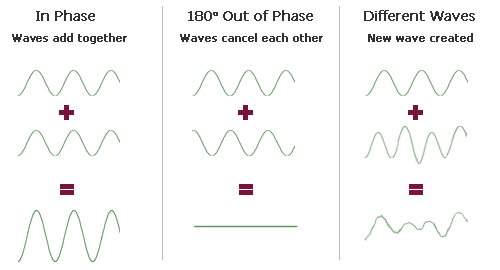
Noise cancelling is a lot more complicated and thus usually a lot more expensive than noise isolating. As you may know, sound travels in waves. Noise cancelling headphones actually produce sound waves that cancel out the most common "noises." Here's a quick diagram from mediacollege.com that shows what happens:

Noise cancelling is the middle example. You have two waves that are complete opposites and when they hit each other they cancel out-- hence noise cancelling. At this point you may be asking how the headphones can make such a sound to do this. Not nearly as easily as noise isolating, that's for sure. Noise cancelling headphones are going to be over the ear headphones, meaning they're actually little cups that go over your entire ear, and in those cups it's going to have the hardware that makes those sound waves and the extra batteries required to make them. That's right, noise cancelling headphones usually require their own separate batteries.

Practical Tip of the Day:
If you're looking for noise reduction during your gym visit, I generally recommend getting noise isolating in-ear headphones. Their smaller design and smaller price point makes them good gym buddies since you won't be walking around the gym floor with big $300 headphones on. If you travel a lot, especially by plane or train, noise cancelling might be better as they can reduce noise more, and generally people find them more comfortable for long-term wear since they don't actually enter your ears.

Tuesday, July 17, 2012

What Does Airplane Mode Do?

Heard the horror stories of people who go on a vacation or travel for work only to find a massive phone bill waiting for them when they get home? Sometimes the people don't even actually leave the country, but get close enough to a border that their phone connects to a cellphone tower on the other side. This happened recently when I took my family to see Niagara Falls. We were close enough to Canada, and far away enough from any cell towers on the US side that our phones connected to Rogers, a Canadian cell phone provider.

What if you don't want to turn your phone totally off, but want to ensure that you don't use the phone or data services? Maybe you're travelling abroad, going into a hospital, or boarding a plane. Simply go to the settings in your smartphone (airplane mode is for smartphones only), and, usually on the main settings screen, you'll see a little switch for Airplane Mode. Just turn it on and voila! It's like turning the phone part of your smartphone off. For iPhone users, I describe Airplane Mode as turning your iPhone into an iPod Touch.

You'll still be able to connect to wifi, but no calls, texts or voice-mails will be sent to your phone while in this mode. As soon as you turn it off, all the above mentioned things you missed will flood in, so don't worry!

Practical Tip of the Day:
When traveling, be careful which wifi networks you connect to. While most are legitimate, some may be monitored by hackers who can watch what you do and even connect to your computer through their network. If you see multiple possible networks, ask an employee of where you are which network is theirs. It's not uncommon to see fake wifi networks with seemingly proper names.

Thursday, July 12, 2012

What Does KB, MB and GB Mean?

In Tuesday's article on What Size Flash Drive You Need, we discussed the different sizes a digital file could be and what their average is. Some files were measured in KB (kilobytes) while others were in MB (megabytes) and still otheres were in GB (gigabtes). This digital capacity measuring system can seem intimidating at first, but once the basics are understood, it's quite simple.

If you're already familiar with the metric system, you have a head start as that is where the prefixes for these measurements comes from. For example, kilometer and kilobyte. The metric system does things in multiples of 100's, but for technology, you'll see it used in multiples of 1,000. Brain hurt yet? Here's a simple breakdown:
  • Kilobyte- 1,000 bytes
  • Megabyte- 1,000 kilobytes
  • Gigabyte- 1,000 megabytes
There are measurements above and below the three measurements given there, but these three will be the ones you primarily see in computers and technology today. Think you've got it? Here's where things get a bit messy; These measurements are really metric and aren't really multiples of 1,000. If you're familiar with how computers work on a basic level and use binary (click here if you aren't) you know you know that they count by 8's, this is called a byte, and therefor instead of a kilobyte being 1,000 bytes, it's actually 1,024 bytes. Will you need to know this? Not unless you want to show off, but it's still good to know and there are nerds out there that will correct you on it.

Practical Tip of the Day:
The 1000 vs 1024 difference doesn't make much an impact on a small scale, but as you start storing more and more data, the impact becomes more and more pronounced. Check out this helpful chart from Wikipedia for a quick reference.

Tuesday, July 10, 2012

What Size Flash Drive Should I Get?

The other day a friend of mine was mentioning that they needed to go to the store and buy a flash drive, but when they were there earlier in the week they were overwhelmed by the vast differences in style and capacity flash drives come in nowadays. (Click here if you don't know what a flash drive is.) While style is completely personal, there are a few tips that can make picking a capacity (or more commonly called "size") of flash drive easier.

The first thing to consider is what you'll be putting on the drive. Are you using it to backup photos? Transferring songs between your computers? Or are you storing important documents and PDFs on it? Different files tend to be larger or smaller than others. For example, a good average size for a word document (1-3 pages of text) is about 20-30 KB (kilobytes). Audio (music, spoken word, etc) is about 1 MB (megabyte) per minute, and photos can vary wildly depending on resolution and file type but tend to be 1 MB or less per photo. (If you don't understand "megabyte" or "kilobyte" check back on Thursday when I'll be covering that topic.)

That being said, a 4 GB flash drive will hold roughly 4,000 photos, 4,000 minutes of audio, or more word documents than any one person would probably ever have for personal use at any one time. When stated like that, most people usually lean more towards getting a smaller (again, we're talking about capacity, not physical size) flash drive. Consider though if you're storing a home video. If you have a nice HD camera, it can take up to- or sometimes surpass- 2 GB (gigabytes) per hour of video. This is because videos contain both an audio track and thousands of pictures to make up the video.

Practical Tip of the Day:
If you're planning on using a flash drive to back up your files, I recommend reconsidering and getting an external hard drive instead. Far too often I've seen clients that have a drawer filled with flash drives that have photos on them, but because of this method, they have to search through the drawer looking for the correct drive if they need it and that's if they had the forethought to label the drives as they filled them. An external hard drive gives you one place to find all of them, making it much easier to locate your files if you need to recover them.

Thursday, July 5, 2012

What is VOIP?

As previously mentioned in the article entitled "What is Skype?" an increasing popular way to make long distance telephone calls, especially out of country, is using a VOIP service like Skype. VOIP stands for "voice over IP," which means that yes, it's an acronym that holds another acronym. "IP" means "Internet Protocol," so to break down "Voice Over Internet Protocol" it simply means that you can talk over the Internet like it's a phone.

To understand why this is impressive, one must first understand the difference between "analog" and "digital." If something is analog, it travels along a continuum. Think of this as the way someone can count between 1 and 2, using a seemingly infinite number of decimals between them. If something is digital, it's more like counting between 1 and 2 (well, 0 and 1 actually), but there are no decimals. It's either one or two. Sound is something that is analog, we can make a wide range of sounds, but computers and other electronic devices only understand digital (click here if you don't know why) so the trick is getting something to sound analog when in fact it's digital. I'll spare you the long explanation as to how that happens.

Once the sound is converted into a digital signal, it can then be sent over the Internet to anywhere you want it to go. When you use a service like Skype, you can "call" people to direct where your digitized voice will be sent to. The nice thing about the Internet is that whether your voice is going across town or across the world hardly changes the delay in conversation so it can simulate a phone very well, and since most countries have a decent connection to the Internet, it can usually also save you money versus using an actual telephone.

Practical Tip of the Day:
If you're travelling abroad, using a VOIP service can save you money versus calling long-distance, but be careful if you're using an "Internet anywhere" card or a smartphone to access the Internet for that purpose as roaming fees for data are often much heftier than roaming fees for voice, and a conversation over VOIP can use a significant amount of data. When travelling abroad, I usually recommend turning off data roaming and using Wifi only if possible to save you from surprise several hundred dollar phone bills when you return.

Tuesday, July 3, 2012

What is Skype?

It's hard being away from the people you love. Grandparents thousands of miles away from grandchildren, a spouse travelling for work, or even just friends scattered to the wind after college. Yes, there's mail, phone, email and a list of other options available, but when you really just want to SEE the person, Skype is often the first program that comes to mind.

Now, mind you, Skype is not just for video chatting (talking to someone over video a la The Jetsons), but also does normal instant messaging, voice calling and is coming out with new and improved features every day. Its bread and butter though, what it's most known for, is video chatting. Both people need to have a Skype account, which is free and easy to set up, and when they're both using the Skype program, they can click a video camera button to start up the cameras on their respective machines and they'll be able to see each other in pretty-darn-close-to-real-time.

A good example of this is actually one of my own stories. When my husband and I were getting married, my mother couldn't come because she had knee surgery and couldn't travel. She had her computer connected to her TV, invited all the family and friends who couldn't make it over, popped popcorn and found comfy chairs. I simply logged into Skype on my smartphone, connected to her, said "Hi," and had one of my cousins hold the phone from the front row so my family thousands of miles away could watch the entire ceremony!


Practical Tip of the Day:
The next biggest thing Skype is known for is called VOIP, which stands for "voice over IP", which, in plain English means, using the Internet like a phone. This is popular because it means that you can make calls between computers instead of having to pay hefty international calling fees. VOIP calls aren't free, mind you, but they are usually significantly cheaper than through the phone companies. Check out Skype's webpage for more information about the costs associated with calling the various countries.

Thursday, June 28, 2012

What Should I Do With My Old Computer?

Recently, I decided it was time for me to get a new computer. My iMac was going on six years old, and while it still surfed the web and typed up documents fine, it was more than a little slow when it came to photo or video editing, which are some of my hobbies. I saved up the money and will soon be the owner of a new MacBook Pro with Retina display. The question I had to ask myself, and that I've been asked by others many times before is what to do with the old computer?

There are definitely options. First, think of anyone you might know who could use it. Anyone who doesn't have a computer at home who might like one? What about local non-profits? Is it still usable and would it be the kind of donation they'd accept? Churches, clubs, etc. can sometimes (but not always) accept donations of old electronics. If you do give your computer away, make sure it's wiped clean of your information first. There are many ways to do this depending on the kind of computer you have, but if you're not familiar with the process, take it to your local computer repair facility. Better safe than sorry with your personal information.

If you can't think of anyone who'd want it, you can try selling it. While most computers devalue quickly enough that you won't be able to get much for them, there are people who will buy old and even broken computers to use for parts. Mind you, you won't usually get much for it, but a little bit of extra cash never hurts. Again, be careful to wipe your computer of your old data, but it's not uncommon to see people selling their computers at garage sales, eBay or even Craigslist.

If niether of those options appeal to you, you can always recycle it. Please, no NOT just throw it in the trash! Many (if not all) of the parts of computers do not biodegrade, and they also contain some things that can be bad for the environment if they break or leak. Call your local computer repair shop and/or recycling facility to see if they accept old computers for recycling. Sometimes there are fees involved, but making sure your compuer stays out of the dump is worth it.

Practical Tip of the Day:
No matter which way you choose to dispose of your old computer, make sure you have a backup of your information before you wipe it off your old computer. This will ensure that even though you have a new machine, you don't have to start over with all your files as well.

Tuesday, June 26, 2012

What's the Best Case for a Laptop?

In short, whatever you want. In long, it depends on where you'll use your laptop, what kind of lifestyle you have, how much you want to spend, and how much you worry about protecting it. There are thousands of different kinds of laptop cases and bags out on the market now, and picking the right one can be difficult.

Where will you use your laptop? Will it only be going from home to the office? Do you travel a lot? Do you live in a sandy and/or wet area? Have kids? Taking your environment into account can help weed out some styles of cases. For example, for a business professional who only goes to the office and home, a briefcase style bag might be best. The computer is unprotected when it's outside of the bag, but the likelihood of something damaging the computer in this case is low. On the other hand, for a college student, a neoprene sleeve or hard plastic case might be best as they give more protection. Some students even use both!

Want a designer case? A lot of major designer brands are making laptop bags now. Laptop bags, as opposed to cases, offer no protection when the computer is outside the bag, and some only offer limited protection inside the bag as well. On the other hand, you can usually get a clear or colored plastic case for less than a fancy bag, and since these "shells" stay on your computer all the time, they offer maximum protection from drops and impact. If you're concerned about being caught in the rain, neoprene sleeves are slim cases your laptop can go into that offer water resistance. (Note: They're not water proof, just resistant.) Sorry there's no clear cut answer for this one, but hopefully using these questions you can narrow your search down reasonably enough that it's no longer overwhelming.

Practical Tip of the Day:
In addition to protecting the outside of your laptop, they also sell screen films to prevent scratches on your laptop's screen and keyboard covers. Keyboard covers help keep liquid and dirt out of your keyboard, the easiest spot for something to enter your laptop. As always, check out reviews for cases and bags online before you buy, and if you're extra concerned, consider either or both of these extra-protectors.

Thursday, June 21, 2012

How Can I Keep My Pet From Chewing My Cables?

New puppy or kitten chew through your $40 HDMI cable or your $80 charger for your laptop? It's not uncommon for young animals to "mouth" objects, but it can be expensive. Instead of getting rid of the newest member of your household, try these inexpensive and animal friendly tips to getting them to stop chewing on your cables, or anything else for that matter.

First, try simple discipline. A spray bottle of water, for example, is a good place to start for getting your pet to stop doing anything. Just make sure that if you're using a spray bottle you already have, it didn't have household cleaners in it previously. The next step of escalation is to try putting something bitter or sour on the cables. Lemon juice is the most commonly used variation of this. Simply rub or spray it onto the cable, making sure you're not getting it on any of the connection ends; The acid from the lemon juice could damage them.

If that doesn't work, spicy is the next step. Pet stores often sell a variation of this for this exact purpose. Generally made from peppers, it's possible to do at home, but please be careful about the strength of the spice, be cautious about allergies for your pets, and make sure the pepper isn't poisonous to your pet. For these reasons, I generally recommend people buy the store brand as they've been tested for all of these things before being sold on the market. If that doesn't work, simply try and keep your cables covered for now. Your young pet will grow out of this phase quickly, so don't give up on it.

Practical Tip of the Day:
One tip for keeping cats off surfaces is to put aluminum foil on it. (Cats hate the stuff evidently.) DON'T do that with your cables! Aluminum can carry an electrical current, so if your pet bites through the aluminum and into a cable carrying electricity it could do serious, or even fatal, damage to them.

Thursday, June 14, 2012

What are Podcasts?

When people first get an MP3 player, (click here if you don't know what that is) they first ask the inevitable question "So now what?" I usually advise people to start with the music they already own, and after that they can buy music, audio books, movies, TV shows... but is there anything in this digital world you can listen to for free?

One of my favorite things to show people is the vast and eclectic world of podcasts. One reason is that podcasts are free! Yay, free stuff! The second is that you can find podcasts about just about any subject you're interested in. Gardening? Check. Cars? Check. Politics, games, parenting, nutrition, news, money. Check to all of those! Just looking for some light entertainment on your morning walk? Many radio shows like NPR also have their radio episodes available as free podcasts as well.

The third reason I enjoy showing people podcasts is because, once they become well versed with using their computer, they can make their own podcasts. Podcasts are not only free to make, but they can also be fairly inexpensive to distribute. There are a decent number of options for getting your podcast out to the world, more than I have time to list here, but they can range for free to expensive based on what you're looking to do.

Practical Tip of the Day:
In addition to all the types of podcasts I listed above, many colleges and universities are now recording their lectures or parts of their lectures and releasing them for free in podcast form. Ever wondered what economics at Yale was like? You can download either a video or audio version of that class to listen to whenever you'd like. Podcasts are a great way to spend long commutes or vacation travel time!

Monday, June 11, 2012

What's the Difference Between Apple's New Laptops?

Yesterday was Christmas for Apple-nerds. WWDC's (World Wide Developer's Conference) keynote address is traditionally a time when major releases are announced, and yesterday was no exception. While we are missing Apple's late former-CEO Steve Jobs, Tim Cooke did a great job of keeping the excitement going and expertly showcasing all of the new products.

The biggest announcement was the new laptop lineup. Apple updated their MacBook Air notebooks ("Notebooks" and "laptops" are synonymous when it comes to computers,) as well as their MacBook Pro notebooks as well. The real surprise though was the announcement of a new laptop line called the MacBook Pro with Retina Display. Retina Display is Apple-ese for "super awesome high quality display." Without getting technical about it, the Retina Display manages to get twice as much detail in the same size screen as the normal MacBook Pro.

Apple actually has a very nice comparison chart on their website (right here) that lets people see a side-by-side comparison of their computer lineups. The only problem I've noticed is that after a line or two most people's eyes glaze over with all the technical jargon, so here's the "quick and dirty" difference. The MacBook Air is good for general use: web browsing, document editing, light photo or video work. If you do more than just basic video, audio or photo work, or just really want a bigger display, consider going to the MacBook Pro. If you're a professional videographer, musician, photographer or anything else that requires a high-powered machine (web designers, I'm looking at you!) or if you just really want that Retina Display, go with the MacBook Pro with Retina Display.

Practical Tip of the Day:
If you're considering getting one of the new Apple notebook computers, also consider getting AppleCare, their warranty program. People generally shy away from any kind of warranty program because, well, honestly, they're usually a rip-off, but AppleCare is actually quite helpful and I buy it for all of my Apple products. It's usually cheaper than even one repair on the computer, covers you anywhere in the world so you're still safe even while travelling, and also gives you unlimited call support. The only caveat is that it's a warranty program, not an insurance program which is illegal for a manufacturer to sell on their own products. This means that AppleCare will cover anything that goes wrong with your computer that's not due to outside forces like drops, liquid spills, etc. I still consider it a great deal though and buy it on all of my Apple products.

Friday, June 8, 2012

How Should I Clean My Keyboard?

Dusters and putties and air, oh my! With so many different ways to clean your computer's keyboard, which way's best? The keyboard is a very important part of your computer, and while they're not terribly expensive, you should clean it regularly to ensure it operates smoothly and has a nice, long life.

Look down at your keyboard. Unless you're using a keyboard with low-profile keys (like Apple uses on their keyboards nowadays) you're likely going to see a lot of gunk under or between your keys. The first step I usually recommend to cleaning your keyboard is just turning it upside down and giving it a little shake. Not hitting it or shaking violently, but a little shake while upside down can help dislodge loose bits.

If your keyboard still has particles of stuff in it, I recommend blowing some canned air into it. Canned air is sold in most electronic stores or departments, and really is just canned, compressed air. Hold the can as upright as you can and blow air between the keys. This usually will help dislodge more stuck-on pieces, and if you give your keyboard another shake you'll likely get more bits coming out.

Note: Do NOT use your canned air while the bottle is inverted. One of the chemicals used in the canning process can flash-freeze items, and therefore you should use caution to keep it inside the can. This is also why your can will get cold after you've used it for awhile.

Practical Tip of the Day:
Noticing the letting on your keyboard is wearing off? Do you use hand lotions? Some lotions can react with the natural oils of your skin to make a slightly acidic oil that then transfers onto your keyboard when you type, slowly eating the lettering away! The best way to prevent this is to either A) Make sure your hands are completely dry after using lotion and before typing. B) Change lotions. or C) Use a plastic keyboard cover. Keyboard covers sit on top of your keyboard helping keep stuff off and out of it. Using a keyboard cover will also make it so you don't have to clean your keyboard as often!

Tuesday, June 5, 2012

How Does Wikipedia Work?

As any teacher will tell you, Wikipedia isn't a citable source of information despite studies showing it's as accurate as the Encyclopedia Britannica. There are plenty of stories of Wikipedia pages being altered with false information, but is it really that bad? Millions of people visit Wikipedia, but just who writes all this stuff? To understand these questions, and to find answers, we must first learn how Wikipedia works.

Wikipedia is a large website that is filled with volunteer generated and maintained information about just about anything you can imagine. ("Wikipedia" is a portmanteau of "wiki," meaning "quick" and "encyclopedia.") Anyone can, anonymously if they'd like, create or edit a Wikipedia page. When you visit a Wikipedia page, next to the header for a subtopic is a link that lets you edit the text in that subtopic.

So how does it maintain reliability? Because it is so easy to edit, people can easily correct mistakes and mark instances where information may be misleading, incorrect, unverified, or biased. In cases where a site becomes vandalized, there are people with special privileges within the Wikipedia community that can prevent anonymous editing for a period of time and can block certain users if they are the ones responsible for the vandalizing

When you visit a Wikipedia page, you'll often see notes that will warn you if a particular statement needs citation, if someone believes it's biased, etc. Reading the superscript notes (smaller words written in the top right corner of another word) can help you ensure that you're reading cited, reviewed works.

Practical Tip of the Day:
If you do need to write a paper, or simply want to look at the sources used in a particular article, there's a section at the bottom of each Wikipedia article entitled "References." These will list the resources used in the article. Similarly, you can click on a superscript number at the end of a statement to view which work was referenced for that information. References may be electronic or print.